
Double-Crossing Cross-Currents
Luck favors the patient

“More as conditions warrant,” is how I close all letters. And usually, by the time conditions have “warranted,” things are fairly clear-cut. Not so with this change of conditions. To handle this one, we’re going to really have to rely on “Strategy,” detailed below.
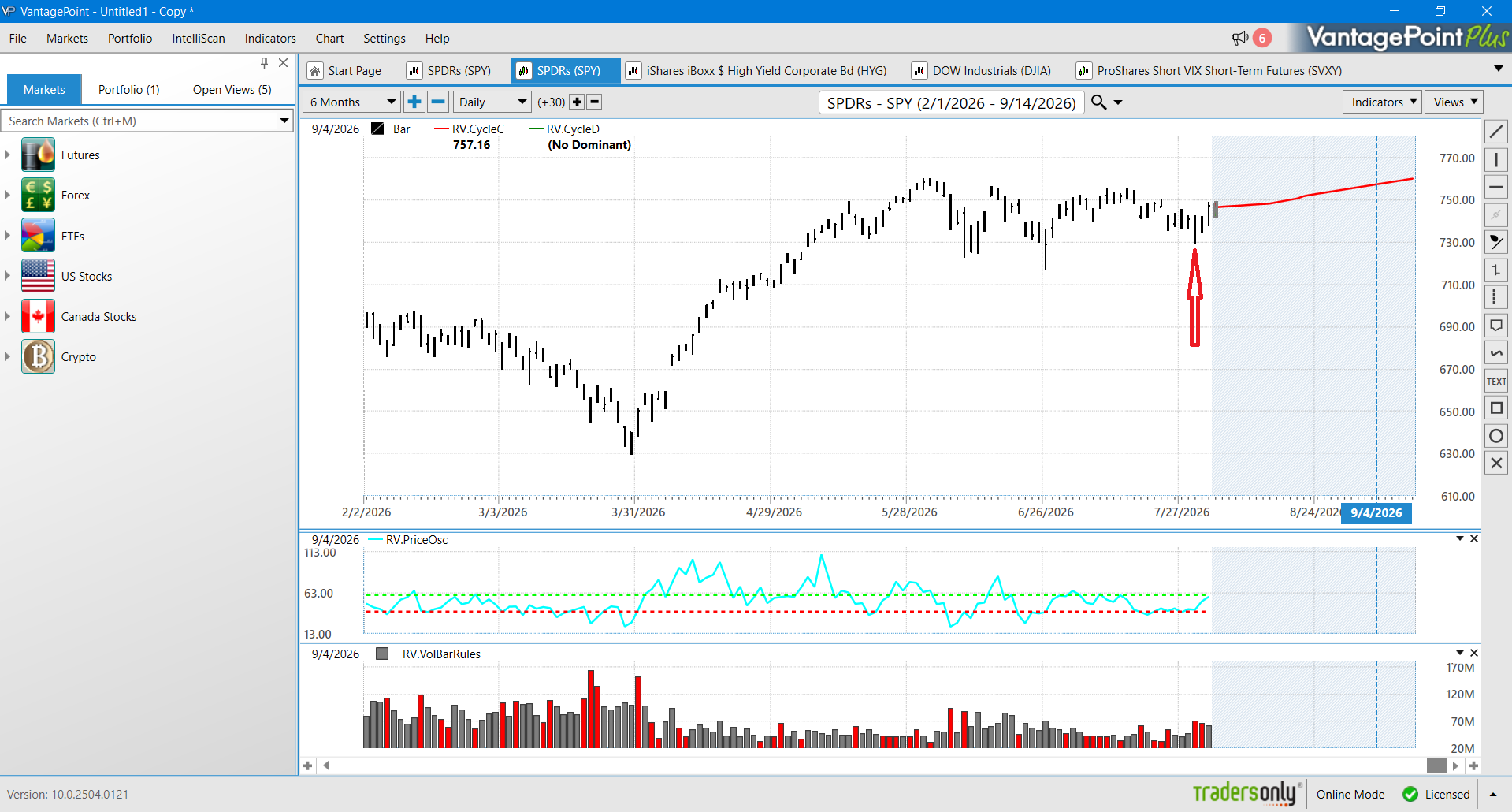
Chart courtesy of Vantage Point Software.
https://www.vantagepointsoftware.com/
https://www.vantagepointsoftware.com/Consider:
We entered a “Period of Extreme Vulnerability,” on July 20:
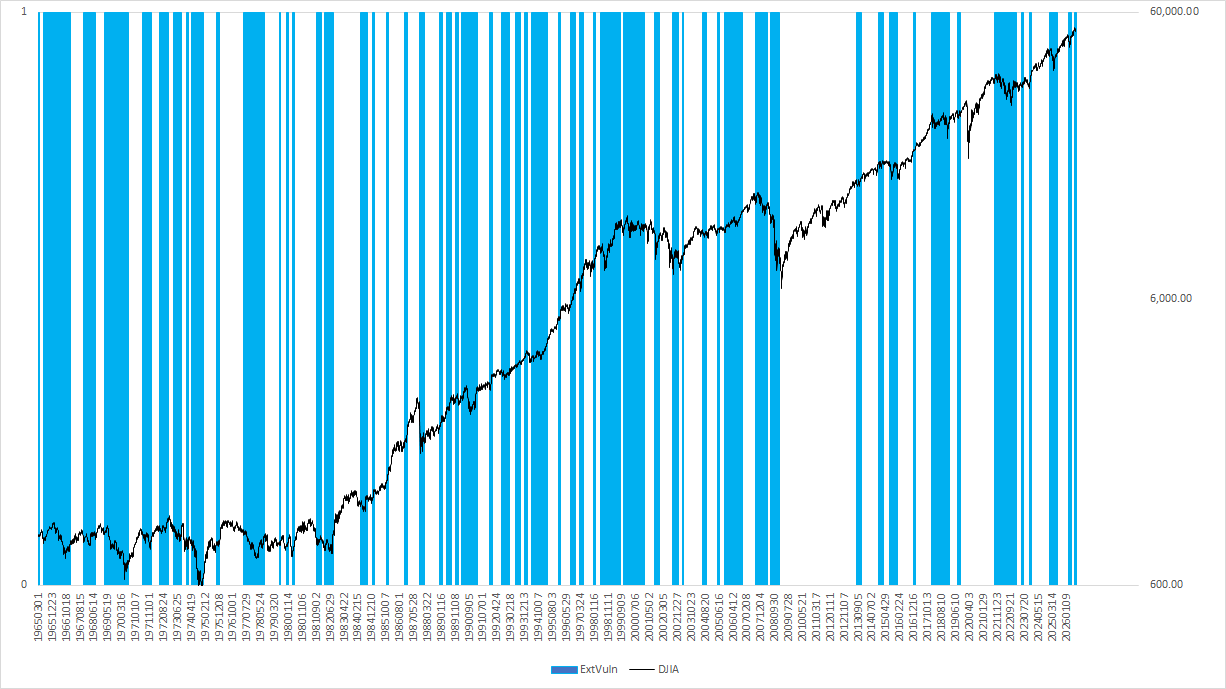
This indicator, based off of new lows (going 90 days without seeing NYSE Daily New Lows / Total Issues) <= .00325 (about single digit new lows under modern conditions) and you enter a period of extreme vulnerability. Not that you have to be in such a period to see a major drop, but every major drop we’ve seen (save for the Covid drop of March 2020) has been during such a period. It doesn’t tell you a drop is imminent, but it is very rare for a major market drop to transpire when we are not ins such a period.
We are no in such a period since 20 July.
Red Compression (also available in Vantage Point Software but not shown here) is flashing now, indicating we are on the cusp of at least a 10-20% move, sometimes considerably more. It doesn’t give us direction, but it does tell us that the market is about to expend some energy.
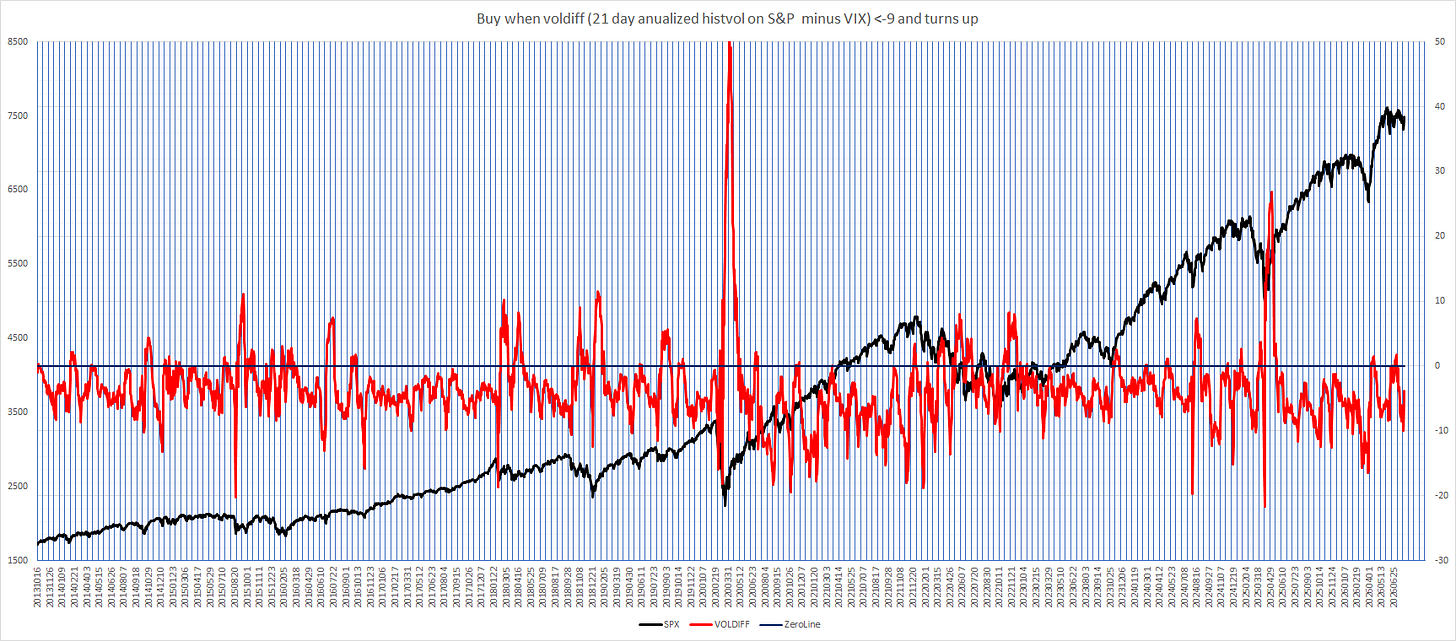
We had an options vol buy signal with Wednesday’s close see the Vantage Point chart, at the top). That is, when the 21-day annualized historical volatility minus VIX gets to -9 then crosses -9 to the upside, this is usually a very solid buy:
We are in the midst of a Volume Tunnel System buy. The volume bars themselves are in red in the Vantage Point chart at the top, the oscillator in the middle of the chart providing direction.
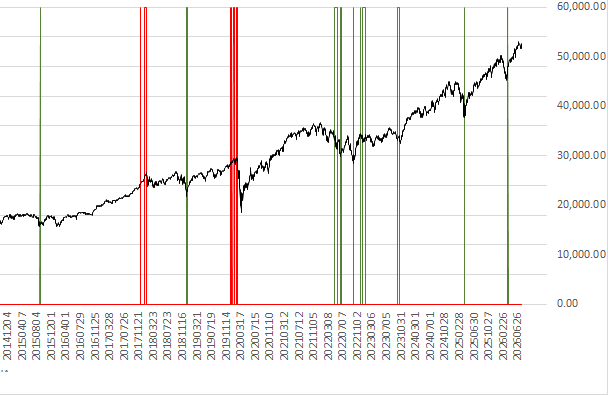
We have a signal based on the 10 day readings of put and call volumes and open interest, which has, historically, provided fantastic buy (green) and sell (red) points, within a hare’s breath of giving us another buy, likely with another drop:
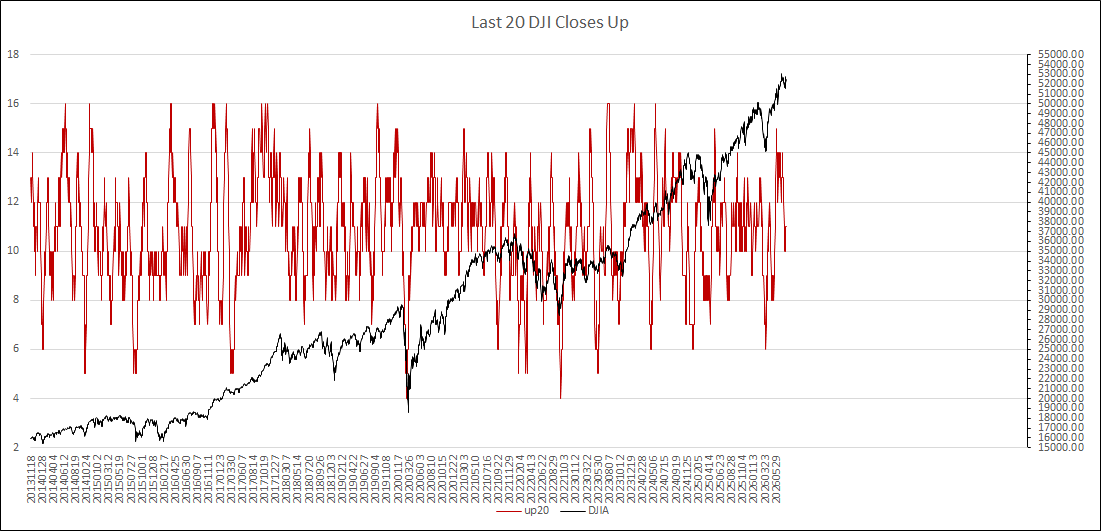
Eleven of the past 20 days in the DJIA have been up. Usually, this indicator ranges from -8 to +12, sometimes going to extremes.
We are no-doubt amidst a giant speculative bubble which, given the strength of the economy (and the continuing nominal strength in employment [despite a myriad of factors, not the least of which is AI, coming for all occupations] amidst a rising rates environment — a typical bull market situation).
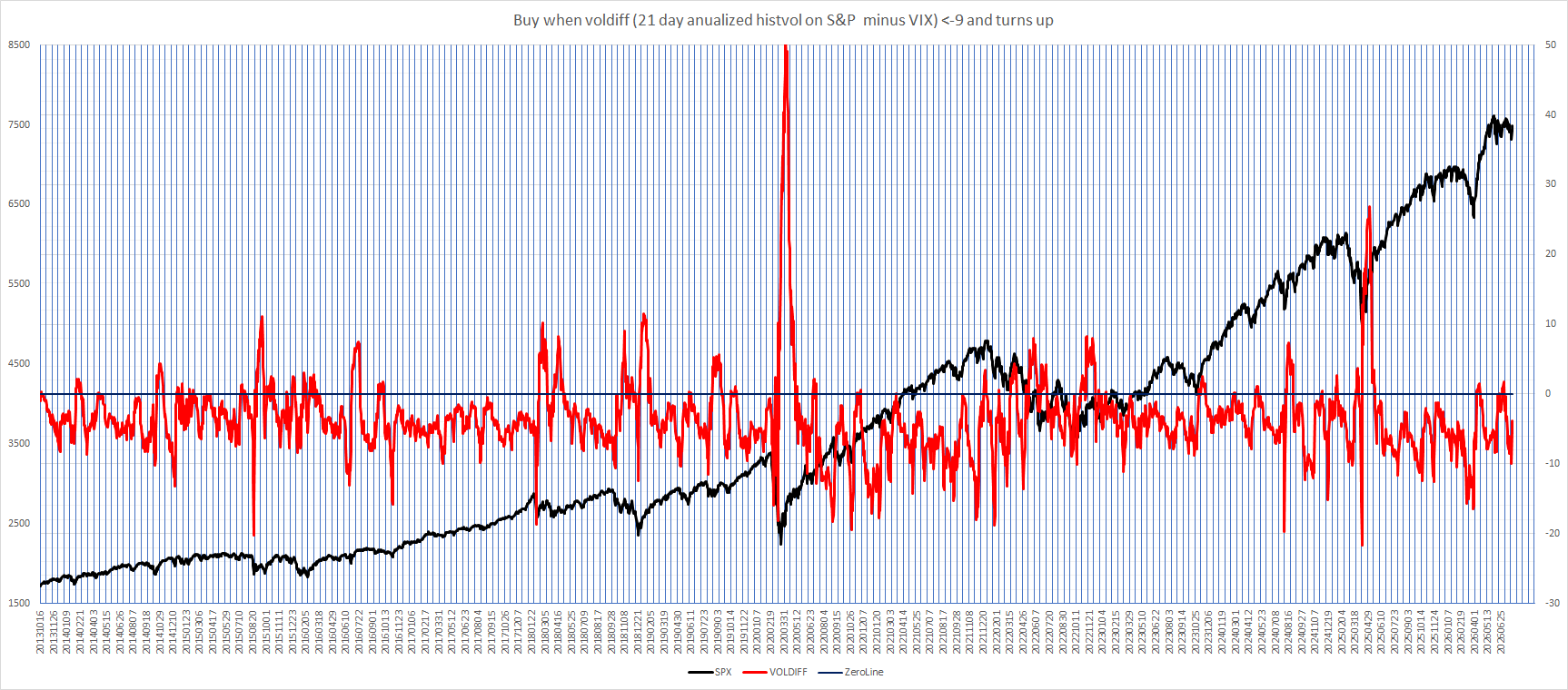
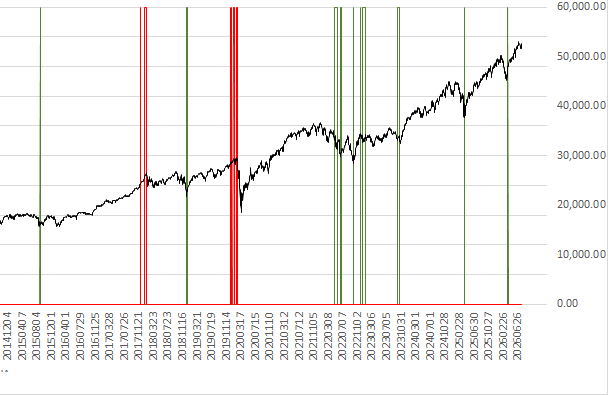
So to aggregate all of this, we should be working a buy here, for a midsummer’s market meltup. The problem, however, is #5 & 6, above. And it is very likely that this market gets hit, perhaps this week, driving #5, to give another of it;s clear, green-band buy signals.
As for #6, still at +11, this time, however, we have not seen a reading <10 since May 19! We are very likely going to see this give us a series of readings South of 10 before any sort of market meltup.
And all of this would be consistent with the Volume Tunnel system, likely to provide another sell signal this week with another up day or two and relatively modest outlier volume. And likely another spike in VIX, driving our reading of historical vol minus VIX back to < -9.
This could constitute one help of an abrupt and steep selloff from here. But you say we may be in the midst of a market meltup now too - or one right around the corner? Periods of Extreme Vulnerability often dissipate without a major selloff, and as you can see from the Vantage Point chart a the top, consistent with Red Compression, this market is grinding in a tight, sideways pattern still, all coiled up.
So hot to play this? We’ll have more to say on this in the Strategy section, below
Lemnicoin
The Lemnicoin project is in full swing now, and with these weeks hack of the coldwallet devices and North of 85 million stolen in Bitcoin, I can only say it is a shame those people didn’t buy LEMNI to protect their Bitcoin.
Right now, LEMNI is about $8/coin — about the price of a beer. With 1 LEMNI you can protect one Bitcoin (~ $63,000) or 1 Bitcoin’s worth of value of other crypto coins (e.g., USDC, USDT, Ethereum). Not only are they protected against wallet / private key theft, but they are further protected against quantum computer attacks.
Native Ethereum is targeting being quantum-sage by 2030, Bitcoin, hopefully, in the early 2030s. LEMNI delivers this now, years ahead of schedule.
Here is why I am so hot on it (and I am no advocating anyone buy or invest in LEMNI, I’m just pointing out A.) Why I like it, and B.) Why I think it is a good way for holders of crypto to protect their crypto for next-to-nothing.
The Standalone Value of Wallet-Theft Protection Alone (forget about the Quantum Resistance for a Moment)
Even if the quantum-resistance problem were already solved by native chain upgrades or competing solutions, LEMNI’s dual-authority (off-chain independent signing verification) mechanism would retain substantial independent value. Wallet-theft proofing addresses a present, recurring threat that no native quantum-resistance roadmap currently solves.
Real-world insurance benchmarks, actuarily-determined, for self-custody Bitcoin risks (theft, wrench attacks, key compromise, physical loss) in 2025–2026 provide a clear anchor:
• AnchorWatch (Lloyd’s of London-backed, self-custody focused): Typical annual premiums of 0.55% – 0.8% of the insured Bitcoin value. Most clients fall in the 0.6–0.8% range.
• Broader institutional crypto crime / custody insurance: Historically 1% – 2.5% of covered value (sometimes higher for hotter setups, lower for strong multi-sig/cold storage).
• Physical-attack / wrench-attack specific cover: Starts around 0.55%.
These are actual market prices for transferring the risk of theft and related perils to an insurer.
LEMNI’s dual-key design specifically targets the single biggest everyday risk for self-custody users: compromise of the wallet private key (phishing, malware, browser exploits, social engineering, etc.). A stolen wallet key alone cannot move the coins.
Most realistic central estimate for effective dual-key style protection: 0.5% – 1.0% per year of the value being protected.
For example, protecting 1 BTC (~$65,000): Annual premium ≈ $325 – $650
Important nuances: This is for theft of the wallet key only. It does not cover seed-phrase compromise (both systems fail if the seed is stolen), physical coercion in every scenario, or quantum attacks. Traditional insurance often still requires the user to follow strict procedures and has exclusions/limits. A cryptographic solution that makes the attack fail by design can be more valuable than a pure indemnity policy.
Key difference with LEMNI: It (insurance) is a one-time cost, not an annual recurring premium. You buy and hold the token once; as long as you continue holding it, the dual-key wallet-theft protection remains active. Moreover, the “cost” is an investment in a very limited-supply (only 10.5 million total), quantum-resistant, wallet-theft-proof ERC-20 token on Polygon. You retain ownership of a scarce asset that can later be sold or transferred.
Because the protection is perpetual (as long as the token is held) rather than annual, the market can capitalize the ongoing insurance-like value into the token price. If Bitcoin goes back to all-time-highs, the $325 – $650 cost for insurance estimate for LEMNI doubles. If it exceeds the all-time-highs, the $325 – $650 cost for insurance estimate for LEMNI triples from these estimates.
Again, I’m not suggesting anyone invest in LEMNI (I am, up to my eyeballs in fact) but I am showing what a great bargain it currently is for protecting whatever crypto users may own.
Strategy
Those willing to risk it here can be long. But an SPY close >751 and (a day of total